 EN
EN

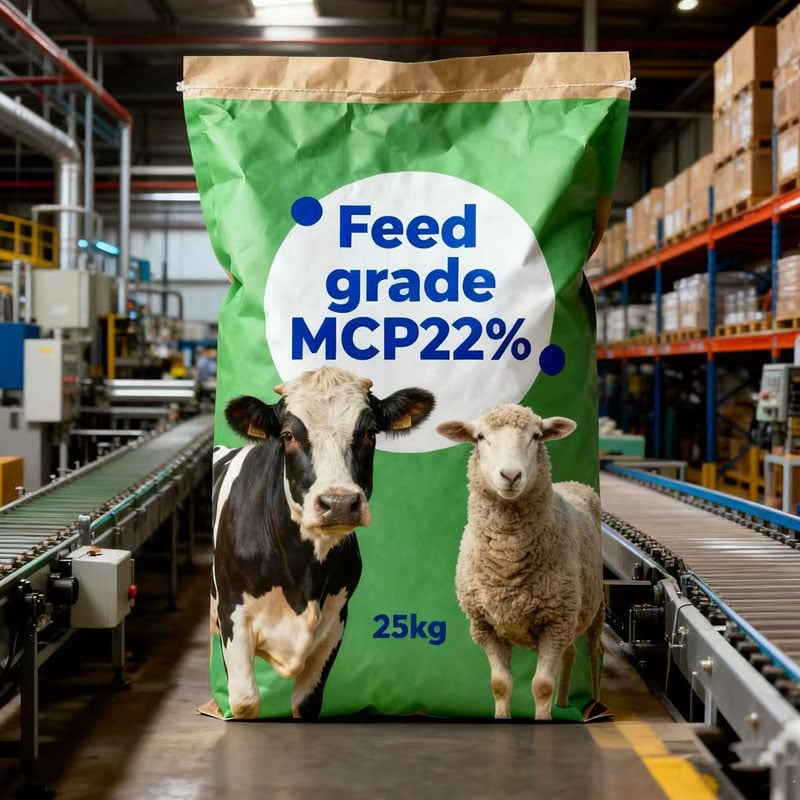
Why Monocalcium Phosphate Is the Preferred Phosphorus Source for Poultry
Superior Bioavailability and Solubility Compared to DCP and TCP
Monocalcium phosphate (MCP) outperforms dicalcium phosphate (DCP) and tricalcium phosphate (TCP) in both solubility and phosphorus bioavailability—key determinants of nutritional efficacy in poultry. MCP contains 22–26% total phosphorus, significantly higher than DCP’s ~18% and TCP’s <15%. Crucially, MCP dissolves rapidly in the acidic environment of the avian proventriculus and gizzard, releasing phosphorus in a form immediately available for absorption. This high solubility is especially vital for young chicks, whose underdeveloped digestive systems cannot efficiently hydrolyze less soluble sources like TCP—which exhibits poor utilization and minimal digestibility in birds. As the industry has shifted from total to digestible phosphorus as the standard metric for formulation, MCP delivers precisely calibrated, highly available phosphorus with lower inclusion rates. This efficiency reduces dietary phosphorus excess, minimizes excretion-related environmental risks (e.g., phosphorus runoff), and supports consistent bone mineralization and metabolic function without over-supplementation.
Optimal Ca:P Ratio for Bone Development and Eggshell Quality
MCP provides a nutritionally advantageous calcium-to-phosphorus ratio that streamlines diet formulation. With approximately 16% calcium and 22% phosphorus, MCP yields a native Ca:P ratio of ~0.7:1—making it an ideal complement to limestone (which supplies calcium without phosphorus). This synergy allows nutritionists to reliably achieve species- and stage-specific targets: the 2:1 Ca:P ratio recommended for laying hens to maximize eggshell thickness and reduce breakage, or the 1.2:1 ratio optimal for broilers to support rapid skeletal ossification and prevent leg disorders. An imbalanced Ca:P ratio—whether from excess calcium binding phosphorus or insufficient calcium—directly compromises bone integrity and shell quality. MCP’s consistent composition ensures batch-to-batch reproducibility, enabling precise, traceable mineral balancing across commercial feed production. For layers, this translates into measurable improvements in shell strength and reduced downgraded eggs; for broilers, it correlates with lower incidence of tibial dyschondroplasia and improved livability.
Practical Inclusion Guidelines for Monocalcium Phosphate in Poultry Diets
Effective incorporation of monocalcium phosphate into poultry feed requires tailored approaches across different production stages.
Stage-Specific Recommendations: Broilers, Layers, and Breeders
Broiler starter diets typically require 0.45–0.50% available phosphorus—most efficiently supplied by MCP at inclusion levels adjusted to meet this target while maintaining a 1.8:1 calcium-to-phosphorus ratio for early skeletal development. Layer diets demand tighter control: 0.35–0.40% available phosphorus supports optimal shell formation without increasing excretion, while broiler breeder rations use 0.38–0.42% to ensure adequate phosphorus transfer to the developing embryo and sustain hatchability. These stage-specific benchmarks prevent both deficiency-driven performance losses (e.g., poor growth, thin shells) and excess-driven environmental and economic costs—including unnecessary phosphorus excretion and formulation inefficiencies.
Synergy with Phytase: Adjusting MCP Levels Using Phosphorus Matrix Values
Phytase supplementation fundamentally reshapes phosphorus economics in poultry diets. By hydrolyzing phytate-bound phosphorus, modern phytases liberate digestible phosphorus previously unavailable to birds—allowing proportional reductions in MCP inclusion. Formulators apply standardized phosphorus matrix values to adjust MCP levels accurately:
| Phytase Level (FTU/kg) | Available P Release (g/kg) | Recommended MCP Reduction (%) |
|---|---|---|
| 500 | 1.0–1.2 | 15–20 |
| 750 | 1.4–1.6 | 25–30 |
These equivalencies must be applied rigorously—using validated, diet-specific matrix values—to avoid under-formulation. Notably, phytase efficacy increases in low-phytate diets (e.g., those containing canola or fermented ingredients), further diminishing reliance on inorganic phosphate supplementation. When integrated thoughtfully, phytase and MCP work synergistically to optimize nutrient utilization, reduce feed cost, and lower phosphorus excretion by up to 30%.
Ensuring Stability and Efficacy: Monocalcium Phosphate in Premixes and Complete Feeds
Compatibility with Vitamins, Trace Minerals, and Feed Additives
MCP demonstrates excellent compatibility in vitamin-mineral premixes and complete feeds. Its neutral pH (~4.0–4.5) and low hygroscopicity limit adverse interactions with sensitive nutrients—particularly fat-soluble vitamins A, D₃, and E—preserving their stability during storage and processing. No significant degradation of phosphorus availability occurs when MCP is co-mixed with choline chloride or copper sulfate, unlike more reactive phosphate sources. That said, prolonged exposure to high humidity (>70% RH) may induce caking and impair flowability, potentially affecting mixing uniformity. Storing MCP—and premixes containing it—in cool, dry conditions (<25°C, <60% RH) maintains physical integrity and ensures consistent delivery of bioavailable phosphorus throughout the feed manufacturing chain.
Balancing Nutrition and Sustainability Through Precision Monocalcium Phosphate Use
Precision poultry nutrition centers on digestible phosphorus—not total phosphorus—as the functional benchmark. MCP aligns seamlessly with this paradigm: its high solubility and bioavailability enable accurate, stage-targeted dosing that meets physiological requirements without surplus. This precision directly curtails phosphorus excretion—reducing potential eutrophication risks in manure-amended soils and waterways—while sustaining bird health, growth, and reproductive performance. When combined with phytase, optimized calcium sources, and responsible sourcing practices, MCP becomes a cornerstone of sustainable feed formulation—supporting both regulatory compliance (e.g., EU phosphorus reduction targets) and operational efficiency. Ultimately, choosing MCP reflects a commitment to science-based nutrition: one that balances animal welfare, productivity, and environmental stewardship through evidence-informed ingredient selection.
FAQ Section
What is the primary advantage of monocalcium phosphate over other phosphorus sources?
MCP offers superior bioavailability and solubility, making phosphorus readily accessible for poultry digestion and absorption.
How does MCP impact feed formulations for laying hens and broilers?
MCP ensures optimal calcium-to-phosphorus ratios for improving eggshell quality in layers and skeletal development in broilers.
Can MCP be used alongside phytase in poultry diets?
Yes, MCP synergizes with phytase by reducing phosphorus supplementation needs and enhancing overall nutrient utilization.
What storage conditions are recommended for MCP?
MCP should be stored in cool, dry conditions, under 25°C and 60% RH, to maintain its physical integrity and bioavailability.
How does MCP contribute to sustainability in poultry farming?
MCP minimizes phosphorus excretion, reducing environmental risks like eutrophication, while supporting animal health and regulatory compliance.
Table of Contents
-
Why Monocalcium Phosphate Is the Preferred Phosphorus Source for Poultry
- Superior Bioavailability and Solubility Compared to DCP and TCP
- Optimal Ca:P Ratio for Bone Development and Eggshell Quality
- Practical Inclusion Guidelines for Monocalcium Phosphate in Poultry Diets
- Ensuring Stability and Efficacy: Monocalcium Phosphate in Premixes and Complete Feeds
- Balancing Nutrition and Sustainability Through Precision Monocalcium Phosphate Use
- FAQ Section